The Challenges of Teaching Chekhov
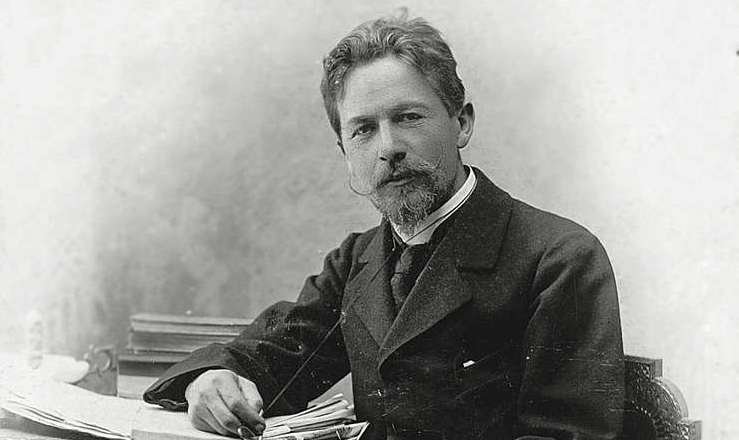
Teaching the playwright Anton Chekhov to high school students is nigh impossible.
Unlike most texts taught in high school—which are rich in beautiful diction, imagery, and figurative language—and thus reward close reading, Chekhov (translated from the Russian, of course) is not really about the language at all. Sometimes it doesn’t even matter what the characters are saying.
Chekhov is not about “the language”—and he’s also not about “the plot”—and teenagers LOVE plot. (I mean, who doesn’t? But having no plot to a teenager means “boring.” Chekhov weirdly resembles Samuel Beckett’s Waiting for Godot where “nothing happens” (though it would be more accurate to say “nothing ostensibly happens.”
If plot is built on conflict, then Chekhov seems to have exchanged “conflict” for—at best—”emotional tension” or “character skirmishes.” As one of my students astutely said when studying The Cherry Orchard, “It’s like there is no antagonist. The ‘antagonist’ of the play is just . . . . life.”
So Chekhov is not about “language” nor “plot”—two staples of the English classroom. No, Chekhov’s artistic genius is subtle—and high school students are decidedly not subtle, nor are they into that sort of vibe. Chekhov upends all students’ expectations of how a play works: the dialogue is disconnected and non-denotative, the language isn’t sumptuous or suggestive (as in, say, Shakespeare), the plot is non-existent, malaise passes for conflict, and Chekhov is so objective and nonjudgmental of his characters’ choices that it feels like the play has no message or theme at all!
Add to all these challenges that Chekhov basically cannot be read and truly understood. Chekhov and Beckett (once again) read completely flat on the page. Chekhov can only be truly understood and appreciated in performance. But compared to Shakespeare (who is always about somewhere), Chekhov is rarely performed around my area—and most Chekhov is performed dreadfully.
Chekhov, in performance, only works if his plays are done in a perfect balance of comedy and tragedy (i.e. “tragicomedy”). Most productions—including films of his plays—err by making everything and everyone into sad, tragic “crybabies” (as Chekhov famously complained) or by turning everyone into farce-like clowns of the sort Hamlet detested.
Out of all the Chekov plays I’ve seen on film, only one did Chekhov “right”: Vanya on 42nd Street. I’ve had more luck with a few audio productions from LA Theatre Works as well. And the undeniable fact of teaching Chekhov is that unless you have some ghost of a Chekhov performance for students to experience, their understanding and appreciation of the playwright is never going to occur.
To teach Chekhov successfully, you have to A) have a film or recording that perfectly balances tragedy and comedy and B) take on Chekhov’s absolutely unique dramatic style head on: tell students that his plays don’t work like other plays.
If you want students to appreciate Chekhov, then the best entryway (also true of Shakespeare) to the gentle doctor is through character. If you can get a student to love or be fascinated—even amused— by character, you’ve got ‘em.
And luckily, Chekhov’s characters are so human as to be extremely likable. Chekhov himself seems to like them all. His characters seem like real people (with real foibles, flaws, hopes, dreams, and desires) even when they are basically standing in for certain types or stereotypes. To me, whose favoritest play in the whole world is The Cherry Orchard, all the characters seem like “my friends.”
But how do you get students to like—or be fascinated—by Chekhov’s characters? You introduce them to each other—and, with delightful Russian directness and simplicity—the characters introduce themselves immediately.
Take the opening scene of The Cherry Orchard, for example:
The play opens either very late at night (2 am!) or early in the morning, and the merchant, Lopahkin is anxiously waiting for the return of Madame Ranevskaya—one of the owners of the cherry orchard along with her idle brother, Leonid Gayer. The Gayev family were once rich because they were slave (or serf) owners, but not that the Emancipation has occurred, the Gayev orchard is in debt and it may be sold if the interest on the mortgage isn’t paid. Because the serfs no longer work for free, the orchard is no longer profitable (no one even picks or sells the cherries anymore) and Leonid spends all his time eating fruit drops playing pool, and giving endless, ridiculous, pompous Poloninus-like speeches.
Lopahkin is a rich merchant who grew up as a serf on the orchard grounds. He tells us about his background right away by telling it to the maid of the Gayev estate, Dunyasha, who is also up waiting for Madame Ranevskays and her entourage to return.
In fact, the opening scene is all about exposition (of setting, situation, and character) in a typically hilarious Chekhovian way. Lopahkin proceeds to tell us (ostensibly to Dunyasha) all about his childhood as a serf with an abusive father, of his obsession with the kind, graceful beauty and generosity of Madame Ranevskays, of how rich he is now—but also how much of an imposter he feels himself to be—a peasant serf, through and through regardless of expensive white waistcoat and yellow shoes. “I’m a pig in a pastry shop,” as he declares in some translations.
Lopahkin tells us his biography—in amusing and horrifying anecdotes filled with self-doubt and self-depreciation—while Dunyasha (not listening or responding to Lopahkin’s tale at all) yaps directly about her identity: how she is very lady-like and has very tender feelings, how she’s always fainting or trembling, how the clerk of the Gayev estate (Yepikhodov) is in love with her and has proposed, and how she doesn’t know if she should accept Yepikhodov’s proposal or not because Yepikhodov is so strange.
What makes this opening so delightful is that it immediately gives us two (funny) characters, a setting and situation, and foreshadows other character introductions (namely Madame Ranevskaya and Yepikhodov) and sets up (most importantly) the beginning of what’s truly going down in a Chekhov play—the Chekhovian network of longing/yearning and tension, i.e. Lopahkin has some sort of Oedipal? romantic longing for Madame Ranevskaya while Dunyasha longs to be a lady and is loved by a man she is not sure she loves back. And while both characters express their longings directly and clearly, neither one of them is really listening to the other very much. Only shards of information break through by chance now and then.
To Chekhov, this lack of listening and connection is (at first) funny, and—if performed correctly—it’s funny to us too. We are never going to get students to enjoy Chekhov is he’s not funny first.
Lopahkin and Dunyasha are just the first two nodes of the Chekhovian network, but look at how much Chekhov has done in just a couple of pages and with such humor, subtlety, and efficiency!
Lopahkin and Dunyasha have scarcely speaking before the third node in the character network walks (or squeaks and stumbles) onstage: Yepikhodov. And we get the amusement (so dependent on the actor’s delivery) of seeing what Dunyasha meant when she said Yepikhodov is strange.
None of what I’ve listed above is easy to sense on the page. Reading Chekhov seems just like “some people are talking.” You don’t realize—unless in performance—that these characters are alive, that they live in a real world (changing) situation, that they have personal issues with their own identities, that they have hopes, longings, and dreams, and (most crucially) that they are hilarious. You literally have to meet these characters in the flesh—or they will always be the dead letter.
So if you’re hankering for teaching a Russian playwright, be warned: Chekhov is so subtle, he’s almost—almost—impossible to teach. But if you can find a performance that does Chekhov right, it can be one of the best times in your English class all year.